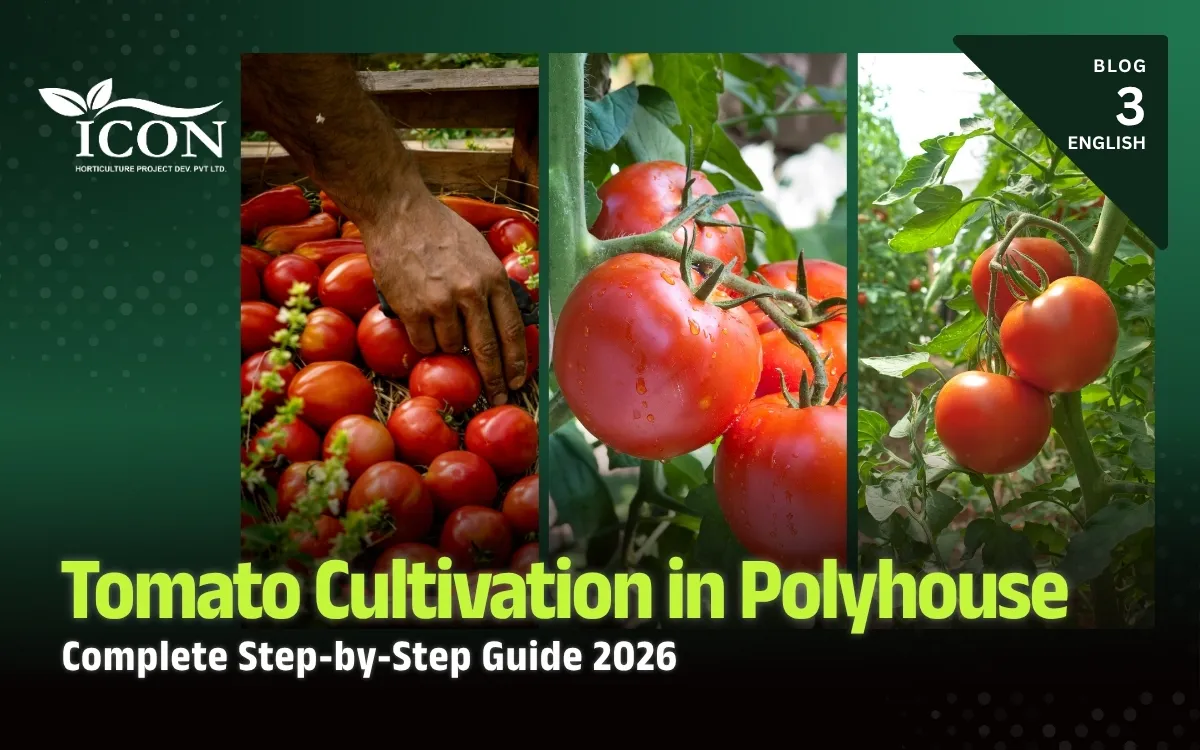
Tomato Cultivation in Polyhouse – Complete Step-by-Step Guide 2026
Across India, thousands of progressive farmers are shifting from traditional open-field farming to polyhouse-based tomato cultivation — and the results speak for themselves. A well-managed polyhouse offers year-round production, freedom from unseasonal rains, and yields that are 3 to 5 times higher than conventional methods. With ICON Horticulture's hands-on experience across 500+ projects in India, this guide brings you a field-tested, practical roadmap to polyhouse tomato farming in 2026.
🌱 Key Insight
A 1000 sq. meter polyhouse can produce 15–25 tonnes of tomatoes per crop cycle (4–5 months), generating a net profit of ₹3–6 Lakh per cycle.
Index
1. Why Grow Tomatoes in a Polyhouse?
- Climate Control: Maintain ideal temperature (18–28°C) year-round regardless of outside weather.
- Drip Irrigation: Save 60–70% water with precision drip fertigation systems.
- Pest Protection: UV-stabilized film blocks insects & reduces pesticide use by up to 80%.
- Higher Yield: Get 3–5× more yield than open field with better quality produce.
2. Best Tomato Varieties for Polyhouse
Choosing the right variety is the most critical decision. Polyhouse varieties must be high-yielding, indeterminate, and disease-resistant.
| Variety | Type | Yield (Tonnes/Cycle) | Best For |
|---|---|---|---|
| Naveen F1 | Hybrid Indeterminate | 20–25 T | All India |
| Kashi Aman | Hybrid | 18–22 T | North India |
| Solan Vajra | Open Pollinated | 12–16 T | Hilly Areas |
| Sarpan 12 | Cherry Tomato | 10–14 T | Export Market |
| Arka Rakshak | Hybrid (IIHR) | 20–28 T | South India |
3. Step-by-Step Cultivation Process
-
1
Nursery Preparation (Day 1–25)
Prepare seedlings in plug trays using a sterile cocopeat-perlite mix (70:30). Sow seeds 1 cm deep and maintain a temperature of 22–26°C. Germination occurs within 5–7 days. Water with a fine mist spray to avoid disturbing seedlings.
-
2
Polyhouse Preparation & Soil Treatment
Before transplanting, sterilize the soil with solarization (cover with clear plastic for 4–6 weeks in summer) or apply Bio-fumigants like Trichoderma. Apply FYM (Farmyard Manure) at 20–25 tonnes/ha and basal fertilizer: DAP 100 kg/ha + MOP 50 kg/ha.
-
3
Transplanting (Day 25–30)
Transplant 25–30 day old seedlings with 4–5 true leaves. Recommended spacing: 60 cm × 45 cm (double-row system). Plant in the evening or on a cloudy day to minimize transplant shock. Water immediately after transplanting.
-
4
Training & Pruning
For indeterminate varieties, use a single-stem or double-stem training system with GI wires and clips. Remove all side shoots (suckers) weekly up to the first flower truss. Prune leaves below the lowest fruit cluster to improve air circulation and reduce fungal diseases.
💡 Fertigation Schedule
0–30 DAT: N:P:K = 19:19:19 @ 2 kg (Vegetative)
30–50 DAT: N:P:K = 12:61:0 + Boron (Flowering)
50–70 DAT: N:P:K = 13:0:46 + Calcium (Fruit Set)
70–120 DAT: Potassium Nitrate 3 kg + Magnesium (Fruit Ripening)
Pest & Disease Management: Key pests in polyhouse tomato are Whitefly, Thrips, Spider Mites, and Leaf Miner. Use Yellow Sticky Traps as the first line of defence (install 10–15 per 1000 sqm). For fungal diseases like Early Blight and Powdery Mildew, apply Mancozeb 75% WP at 2.5 g/liter as a preventive spray every 15 days.
Harvesting: Tomatoes are ready for harvesting 60–80 days after transplanting. Harvest at the breaker stage (30–40% colour change) for distant markets, or at full-red stage for local markets. Harvest every 2–3 days during peak production.
4. Profit & Cost Analysis (1000 sq. meter Polyhouse)
| Item | Cost/Income |
|---|---|
| Seeds, Nursery Material | ₹5,000 – ₹8,000 |
| Fertilizers & Fertigation | ₹15,000 – ₹20,000 |
| Plant Protection Chemicals | ₹6,000 – ₹10,000 |
| Labour (4–5 months) | ₹30,000 – ₹40,000 |
| Water & Electricity | ₹5,000 – ₹8,000 |
| Total Input Cost | ₹61,000 – ₹86,000 |
| Expected Yield | 18–25 Tonnes |
| Average Market Price | ₹18–₹30 per kg |
| Gross Income | ₹3.24 – ₹7.5 Lakh |
| Net Profit (per cycle) | ₹2.5 – ₹6.5 Lakh |
5. Government Subsidy Available
Under NHM (National Horticulture Mission) and RKVY, farmers can get 50% to 90% subsidy on polyhouse construction cost. For a 1000 sqm polyhouse, the subsidy can range from ₹7.5 Lakh to ₹13.5 Lakh. ICON Horticulture provides complete paperwork support for subsidy applications.
🚀 Start Your Polyhouse Tomato Journey Today!
From design & construction to crop management & subsidy — ICON Horticulture is your complete partner.
Get Free Consultation →